Nota: Essa é uma tradução
Índice
- THE POINT OF THE DIFFICULTY.
- THE BEGINNINGS OF THE HERESY
- THE LETTER OF HONORIUS.
- ST. SOPHRONIUS OF JERUSALEM INTERVENES
- THE ” ECTHESIS ” OF HERACLIUS
- THE APOLOGY OF JOHN IV.
- THE RECANTATION OF PYRRHUS.
- THE CONDEMNATION OF PAUL, AND THE RELAPSE OF PYRRHUS
- THE “TYPUS” OF CONSTANS AND PAUL.
- ST. MARTIN’S LATERAN COUNCIL OF 649
- PUBLICATION OF THE LATERAN DECREE
- PERSECUTION AND MARTYRDOM OF THE POPE
- THE TRIAL OF ST. MAXIMUS AT CONSTANTINOPLE
- EXILE AND DEATH OF ST. MAXIMUS AND HIS COMPANIONS
- THE CONVOCATION OF THE SIXTH CECUMENICAL COUNCIL
- THE LETTER OF POPE AGATHO TO THE SIXTH COUNCIL
- THE POPE GIVES HIS ORDERS TO THE COUNCIL
- THE COUNCIL DEPOSES MACARIUS OF ANTIOCH
- POPE HONORIUS IS CONDEMNED AS A HERETIC
- THE COUNCIL’S FORMAL DECREE ACCEPTING THE POPE’S LETTER AS HE HAD DEMANDED
- THE COUNCIL DESCRIBES THE POPE’S AUTHORITY
- THE EMPEROR DESCRIBES THE PREROGATIVES OF ROME
- PAPAL INFALLIBILITY AND THE SIXTH COUNCIL
- THE CONDEMNATION OF POPE HONORIUS IS CONFIRMED BY NUMEROUS PONTIFFS AND BY TWO ECUMENICAL COUNCILS
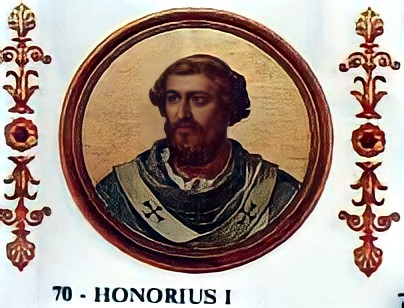
The Condemnation of Pope Honorius
1. The Point of the Difficulty.
MUCH ink has been spilt in the cause of Pope Honorius. Some writers have been chiefly occupied in defending or assailing the authenticity of the documents, others in attacking or supporting the orthodoxy of Honorius. But the inner sequence of events as described in the following sketch has never been given in all this voluminous literature.
Though it will, I hope, be made clear in these pages that much has been misunderstood or only half understood, yet the work of so many distinguished writers has no inconsiderable value. Certainty has been attained on some points. The authenticity of the documents is now above suspicion. It has been made clear that Honorius’ meaning was far better than his expression, and that his real mind was confused rather than un-orthodox.
This is not, however, a very important point, since at the present day no one is likely to teach that Honorius published his famous letters ex cathedra. The real difficulty has been worded with admirable precision by Bishop Gore in his Roman Catholic Claims. He says:
“Once again, whatever strong language may be quoted from a few later Oriental writers on behalf of the Roman See, as from St. Theodore the Studite in the 8th century, nothing can override the evidence of the formal action of the sixth General, Council in 689, when it con- demned Honorius the Pope among the Monothelite heretics. ‘With them we anathematize’, says the Council, ‘and cast out of the Catholic Church, Honorius, who was Pope of the elder Rome, because we found that he followed Sergius’ opinion in all respects and confirmed his impious dogmas’. Roman Catholic writers may endeavour to justify the actual language of Honorius, they may protest that the contemporary Pope never intended to assent to his condemnation except for negligence in opposing heresy we are not concerned at present with these contentions but no one can possibly, with any show of reason, contend that the insertion of the name of the Pope in a list of formal heretics by an ecumenical Council does not prove that the Bishops who composed the Council had no, even rudimentary, idea of the papal infallibility” (pp. 103, 104).
As the history of Pope Honorius has been written up till now by Catholic apologists, this indictment is unanswerable. Bishop Gore’s admission with re- gard to St. Theodore the Studite might have suggested to him that his conclusion was not certain, had not so many Catholic writers made it seem that the Council in condemning Honorius was resisting the Pope of its own day, and that the latter explained away a decision which he was afraid of refusing to confirm.
In reality, as the history will appear from the original documents, there is no difficulty at all. The Pope and the Council were in agreement as to the necessity of condemning Honorius, and they were certainly right in doing so under the circumstances. It will also be made clear that there was no difference between Rome and the East with regard to the force of papal decisions. We do not of course look for the enunciation of the Vatican decree in set words by Eastern Bishops of the 7th century. But evidence will be supplied to enable us to judge the degree of development which the doctrine of papal infallibility had reached in those times, and the whole history will stand out as an interesting and curious page in the history of the evolution of the dogma.
I shall avoid controversy either with Catholics, Gallicans, or Protestants. The facts will best speak for themselves, and I leave the comparison with the views of former writers to be made or not by the reader as he chooses, so as to avoid burdening these pages with tiresome arguments.
2. The Beginnings of the Heresy.
The origin of Monothelitism is thus told by Sergius¹. The Emperor Heraclius, in a disputation held before him in Armenia in 622, had spoken of “one operation” in Christ, and had later asked Cyrus, Bishop of Lazoe in Phasis, whether this was correct². Cyrus replied that he did not know, and referred the question to Sergius, Patriarch of Constantinople. Sergius was in favour of the expression, and sent him a letter said to have been addressed by the Patriarch Mennas, his predecessor, to Pope Vigilius, in which “one operation” was mentioned. Sergius declared that he intended no absolute decision on the matter. Cyrus, however, was satisfied. About 630 he became Patriarch of Alexandria, one of the strongholds of the Monophysites. These were very much divided among themselves, and Cyrus induced one considerable section of them to be reconciled with the Catholic Church by a sort of compromise, which was nicknamed “the watery union”. The doctrine agreed upon was summed up in nine propositions, which profess to render the teaching of Chalcedon, but express themselves in Monophysite phraseology, borrowed indeed from St. Cyril, but meant in a wrong sense by the heretics. The seventh of these propositions anathematizes all who do not confess that the same one Christ works both the divine and human works by “one theandric operation”. This expresses the main thesis of Monothelitism.
Nothing could be more pleasing to the Emperor and Sergius than such a union, and the latter wrote a joyful letter of congratulation to Cyrus. But the Palestinian monk, Sophronius, was in Alexandria at the time, and he disapproved of ‘the teaching of “one operation” as contrary to the Chalcedonian doctrine. His reputation for sanctity was great, and Cyrus proposed that he should lay his objections before Sergius. Sophronius accordingly
proceeded to Constantinople, and so far persuaded Sergius that he withdrew the “one operation” for the sake of peace, and Sophronius promised to say no more. It is evident that Sergius now distrusted this formula, but could not formally withdraw it without imperilling the union of the Alexandrian heretics.
In this dilemma he took the obvious course of laying the whole matter before the Pope.
3. The Letter of Honorius.
His famous letter to Honorius³ begins by saying that he would desire, were it possible, to bring all his actions day by day to the Pope’s cognizance and receive his advice. He relates the circumstances, how very hard it seemed to destroy the recent joyful union effected by Cyrus, with all its promises of peace, “of those who once would not hear the name of the divine Leo and the Council of Chalcedon, but who now proclaim them in a loud voice in the holy mysteries”. Sophronius, he says, was not able to quote explicit testi- monies of the ancients for two operations ; but it seemed that the term ” one operation “was novel, and he, Sergius, had therefore written to Cyrus to permit neither one nor two operations to be spoken of, when once the union of the Monophysites with the Church had been effected. Sophronius had agreed to this. At the end of the letter Sergius quotes the celebrated words of Pope Leo, Agit enim utraque forma cum alterius communione, which obviously imply two operations ; and he seems to have been orthodox enough in meaning, though
his expressions are incorrect. He has started from the Chalcedonian doctrine, but has made a sorry conclusion. He does not openly support one will, which he only mentions in connection with the supposititious letter of Mennas to Pope Vigilius, but he thinks “two operations” to be a misleading expression. He concludes: “We have thought it fitting and also necessary to give an account to your Brotherhood and concordant Blessedness, by the copies which we are sending, of what we have partially related above; and we beg your Holiness to read the whole, and, following its meaning with your God pleasing and full charity, if there be anything wanting in what has been said, to rill this up with the chanty which God has given you; and with your holy syllables and with your desirable assistance, to signify your opinion on the matter.”⁴
The letter of Honorius, in reply⁵, praises Sergius for his circumspection in disapproving the new expression, “one operation”. So far so good. But he goes on to admit one will, because our Lord took to Himself a human nature free from the curse of original sin. The reason given implies that our Lord has a human will, only not also a corrupt lower human will. This is in ansxver to Sergius, who had argued that if two operations were admitted there would follow two contrary wills. The Pope declares that to teach one operation will seem Eutychian, while to teach two will seem Nestorian. Both expressions are consequently to be avoided.
Honorius is thus logically and theologically as much astray as Sergius, though both are orthodox in intention. It would no doubt be uncharitable to regard either the Pope or the Patriarch as a “private heretic”.
Unfortunately these letters were afterwards treated as if they were definitions of faith. As definitions they are obviously and beyond doubt heretical, for in a definition it is the words that matter.
It is, of course, absurd to regard the letter of Honorius as a definition ex cathedra, as was done by Hefele, Pennacchi and others. It was natural to exaggerate at the time of the Vatican Council, but today the decree is better understood. If the letter of Honorius to Sergius is to be ex cathedra, a fortiori all papal encyclicals addressed to the whole Church at the present day must be ex cathedra, quod est absurdum.⁶
The decision of Honorius was nothing more and also nothing less than an approval given to the disciplinary arrangement suggested by Sergius. Both believed that ” one will ” had been said, and said in an orthodox sense, by the orthodox Mennas, unrebuked by Pope Vigilius, and neither was aware that ”two operations” and ” two wills ” could be shown to have been consecrated by the usage of the Fathers. Sergius was at least doubtful, and set the matter before the Pope. Honorius had a higher responsibility ; he decided in haste to agree with the con- duct of Sergius, and he decided wrongly. The result of his letter was the so-called heresy of Monothelitism, which up to this point can scarcely be said to have as yet existed, except as an opinion under discussion.
4. St. Sophronius of Jerusalem intervenes.
 Título do site