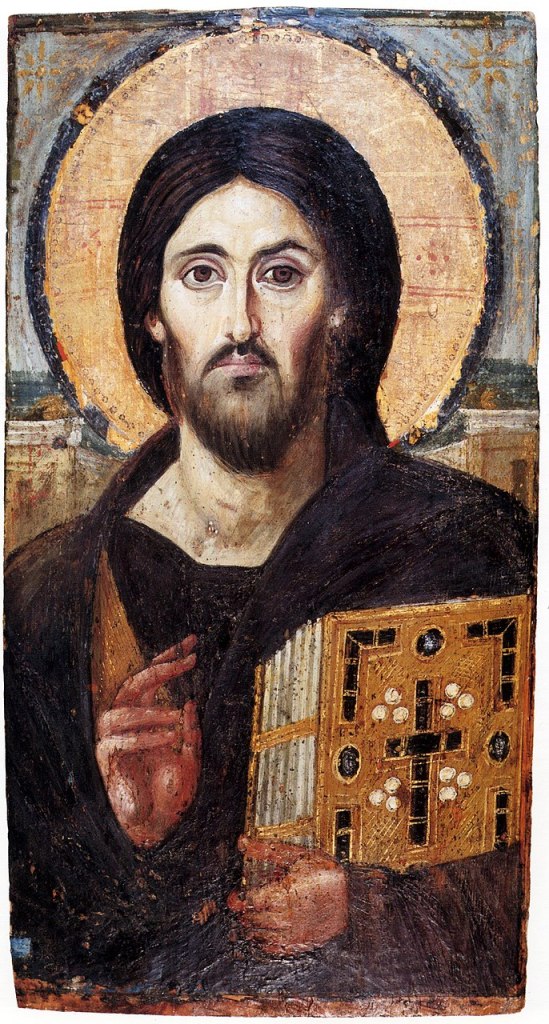
GOD’S HUMAN FACE
CHRISTOPH SCHÖNBORN, O.P.
God’s Human Face
The Christ-Icon
Translated by Lothar Krauth
IGNATIUS PRESS SAN FRANCISCO
Originally published as L’Icône du Christ. Fondements théologiques élaborés entre le Ier et le IIe
Concile de Nicée (325—787 A.D.), Editions Universitaires, 2nd ed. (Fribourg, 1976, 1978); Coll.
Paradosis XXIV. This translation was made from the German edition, Die Christus-Ikone. Eine
theologische Hinfuhrung (Schaffliausen, Germany: Novalis Verlag, 1984).
Cover design by Roxanne Mei Lum
Cover illustration: Christ the Pantocrator
Encaustic icon, 6th century (detail)
Photo by J. Galley-Schwitter A. G. (Basel)
© 1994 Ignatius Press
(…)
ISBN 0-89870-514-2 (PB)
ISBN 978-1-68149-212-4 (EB)
Library of Congress catalogue number 94-75957
Printed in the United States of America
In memory of
Father Marie-Joseph Le Guillou, O.P.
(1920—1990)
whose help and fraternal guidance
made this work possible
CONTENTS
Abbreviations
Preface
PART ONE: THE THEOLOGICAL FOUNDATIONS
OF THE ICON
Chapter One: The Trinitarian Foundations
I. The Eternal Image
CONTENTS
Abbreviations
Preface
PART ONE: THE THEOLOGICAL FOUNDATIONS OF THE ICON
Chapter One: The Trinitarian Foundations
I. The Eternal Image
- The Place of Images in the System of Arius
- Athanasius: The Word as Consubstantial Image
II. Toward a New Understand of Personhood
- The hypostasis Controversy
- Nature and Person
a. The philological approach to ousia and hypostasis
b. A theological approach to personhood
c. The Person of the Son as the icon of the Father
d. Person and countenance (hypostasis and prosôpon)
III. The Work of the Son as the Image of the Father
- Generation and Subordination
- The Divine Persons and Their “Mode of Existence”
- Obedience and Freedom
Chapter Two: The Christological Foundations of the Icon
I. Origen—An Iconoclastic Christology?
II. An Iconoclastic Theology: Eusebius of Caesarea (c. 264—340 A.D.)
- Eusebius’ Letter to the Empress Constantia—A Theological Blueprint of Iconoclasm
- The “Image of God”—Indicating the Subordination of the Logos
- The Universal Activity of the Logos
- The Icon of Christ and Anthropology
- Eusebius’ Sacramental Conception of the Image
III. “God, Visible in the Flesh”: Cyril of Alexandria (d. 444 A.D.)
- “The Glory of God Shining on the Face of Christ” (2 Cor 4:6)
- “Whoever Sees Me, Sees the Father” (Jn 14:9)
- The Flesh of the Word
IV. Love as the Icon of God: Maximus Confessor (580—662 A.D.)
- Nature and Person—A Detailed Analysis of Their Correlation
- The “Composite Hypostasis”
- A New Mode of Existence
- The Two Activities and Wills in Christ
- Christ, “the Living Icon of Love”
- “Image and Symbol of Himself”
- Summary and Perspective
PART TWO: THE ICON OF CHRIST AND THE IMAGE CONTROVERSY
Chapter One: The Theological Outline of the Byzantine Iconoclastic Controversy
I. The Dispute as to the Causes of the Byzantine Iconoclastic Controversy
II. The Church Sliding into Paganism? Theological Arguments against the
Veneration of Images
- Abuses in the Cult of Images
- “Thou Shalt Not Fashion for Thyself an Image” (Ex 20:4)
- Matter and Spirit
- The Consubstantial Image
- An “Origenian” Approach
III. The Christology of the Iconoclasts
- The Emperor Constantine V
a. The union of the two natures in Christ
b. The concept of the image
c. The icon of Christ - The Synod of 754 A.D.
a. The union of the two natures in Christ
b. A hidden error
Chapter Two: The Defenders of Images
I. The First Period of the Icon Controversy: The Icon, a Monument to the Incarnation
- The Icon as “Representation of Christ’s Flesh”: Germanus of
Constantinople - The Struggle of the Monks: George Cyprius
- The Icon as Grace-Filled Matter: John Damascene
II. The Second Council of Nicea (787 A.D.)
III. The Golden Age of Icon Theology
- The Patriarch Nicephorus of Constantinople (750—829 A.D.)
a. “To circumscribe” and “to paint”—clarifying the concepts
b. The image as a relation of similarity
c. The christological realism of St. Nicephorus
d. A defective Christology? - The Abbot Theodore the Studite (759-826 A.D.)
a. The icon: image of the person
b. The icon: location of a personal presence
c. Seeing with physical or spiritual eyes?
d. The icon: the seal of God’s self-humiliation
Conclusion
Notes
 Título do site